



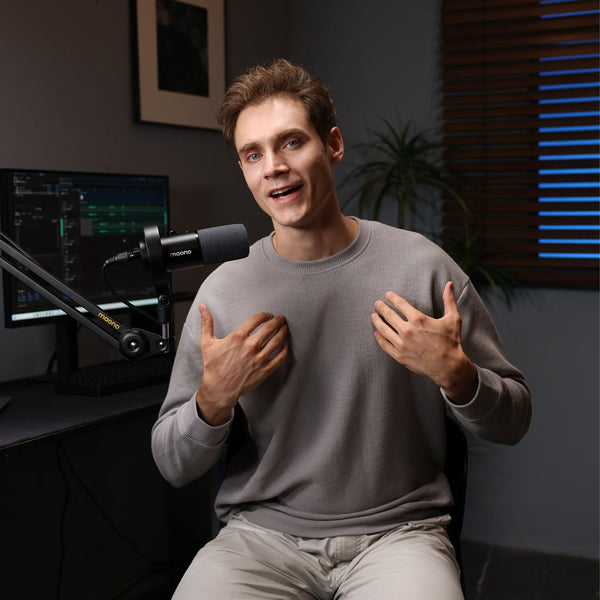
When it comes to choosing the right microphone for your recording needs, the debate often narrows down to two types: dynamic cardioid mics and condenser cardioid mics. Both have unique characteristics and are suited to different recording environments and purposes.
To answer this question about a dynamic cardioid mic versus a studio condenser microphone and which one to choose, the answer depends on the intended use of the microphone buyer. Take into account that condenser mics can also have a cardioid pickup pattern. It’s one of the types of microphones describing a polar pattern, which is cardioid and directional.
In this guide we will delve into the differences, functionalities, and applications of dynamic and condenser microphones, and learn about the different polar patterns, helping you make an informed decision when purchasing a microphone.
Dynamic Microphones vs. Condenser Microphones: Differences and Which to Use
What is a Microphone Diaphragm?
The diaphragm is a crucial component of a microphone, responsible for converting sound into an electrical signal. It vibrates in response to sound waves, and these vibrations are then transformed into audio signals. The type and size of the diaphragm play a significant role in determining the microphone's sensitivity and tonal quality.
What is a Dynamic Microphone?
Dynamic microphones are robust, versatile mics that are often used in live sound settings. They are known for their durability and ability to handle high sound pressure levels (SPL), making them ideal for capturing loud sound sources like drums and guitar amplifiers.
How Does a Dynamic Microphone Work?
Dynamic microphones operate using electromagnetic induction. Inside the mic, there's a diaphragm attached to a coil of wire. When sound waves hit the diaphragm, it moves the coil within a magnetic field, generating an electrical current that mirrors the sound wave. This simple and effective mechanism allows dynamic mics to be reliable and sturdy.
What is a Condenser Mic and Why It Matters
A condenser mic is a highly sensitive microphone designed to capture sound with exceptional detail and accuracy. It is widely used in studio environments for recording vocals, acoustic instruments, podcasts, and voiceovers because it can reproduce subtle nuances that other microphones may miss. Unlike dynamic microphones, a phantom power condenser mic requires an external power source—most commonly 48V phantom power supplied by an audio interface, mixer, or USB connection—to operate its internal electronics. USB options are also available as USB condenser mic options, providing convenience for home setups.
Condenser microphones work using the principle of capacitance. Inside the mic, a thin, electrically charged diaphragm is positioned extremely close to a solid backplate, forming a capacitor. When sound waves strike the diaphragm, they cause it to vibrate, changing the distance between the diaphragm and the backplate. These changes alter the capacitance, which is then converted into an electrical signal that accurately represents the sound. This design allows condenser mic frequency response to be wider and capture finer sound detail compared to dynamic microphones.
One distinction among condenser microphones is diaphragm size:
-
Large diaphragm condenser mic models are popular for vocal recording because they produce a warm, full sound and are more forgiving of minor performance variations, making them the best condenser mic for vocals.
-
Small diaphragm condenser mic models excel at precision and consistency, making them ideal for recording acoustic guitars, pianos, drum overheads, and other instruments where clarity and transient detail are crucial.
What truly sets a condenser mic apart from a dynamic mic is its higher sensitivity and faster transient response. While this makes studio condenser mics perfect for controlled recording environments, it also means they can pick up background noise more easily—making room treatment and proper mic technique especially important.
Main Similarities and Differences Between Condenser and Dynamic Microphones
Both condenser and dynamic microphones convert sound waves into electrical signals, but they do so in fundamentally different ways. Studio condenser microphones are generally more sensitive and have a wider frequency response, making them ideal for capturing detailed audio in controlled environments. Dynamic mics, on the other hand, are more rugged and better suited for high-volume applications and live sound.
Pros and Cons of Dynamic and Condenser Microphones
Dynamic Microphones:
- Pros: Durable, handles high SPL, no external power needed, less sensitive to ambient noise.
- Cons: Limited frequency response, less sensitive, heavier.
Condenser Microphones:
-
Pros: Wide condenser mic frequency response, high sensitivity, ideal for studio use.
-
Cons: Fragile, requires phantom power condenser mic, more susceptible to environmental noise.
Condenser Mic Sensitivity vs Dynamic Mic Sensitivity
One of the differences between condenser and dynamic microphones lies in sensitivity—or how well each type responds to subtle changes in sound.
Condenser microphones are designed with lightweight diaphragms and sensitive internal circuitry that react quickly to even the softest sound waves. This high sensitivity allows condensers to capture more nuance and detail across a wide frequency range. That makes them especially well-suited for music recording, studio vocals, acoustic instruments, and high-quality content creation, where preserving the natural tone, overtones, and texture of the source is essential. Their ability to pick up delicate transients and quiet sounds helps recordings feel richer and more lifelike.
In contrast, dynamic microphones use heavier diaphragms and more rugged designs that are less responsive to subtle sonic variations. While this makes them excellent for handling loud sources and rejecting background noise, it also means they won’t capture the same level of fine detail as condensers. For content creators recording in treated environments—such as voiceovers, podcasts, or studio music sessions—the enhanced sensitivity of a studio condenser microphone often results in clearer, more expressive sound.
This sensitivity difference is a major reason condensers are preferred in controlled settings where detail and fidelity matter most.
USB vs. XLR Microphones
What is a USB Microphone?
USB microphones are easy to setup, plug-and-play devices that connect directly to a computer via USB. They have built-in preamps and analog-to-digital converters, making them convenient for home recording and podcasting.
What is an XLR Microphone?
XLR microphones use a three-pin XLR connector and require an audio interface or mixer to connect to a computer or recording device. They are standard in professional audio settings due to their superior audio quality and versatility.
Pros and Cons of USB and XLR Microphones
USB Microphones:
- Pros: Easy to use, no additional equipment needed, portable.
- Cons: Limited upgrade potential, generally lower audio quality compared to XLR mics.
XLR Microphones:
- Pros: High audio quality, versatile, upgradable.
- Cons: Requires additional equipment, more complex setup.
What to Consider When Choosing Between a Dynamic Mic vs. Condenser Mic, XLR Mic vs. USB Mic
1. Budget
Dynamic microphones and USB mics are generally more affordable than condenser and XLR microphones. Your budget will play a significant role in your choice. But there are also very affordable dual USB/XLR microphones that offer superb quality. Check out Maono’s USB&XLR microphones.
2. Frequency Response
Condenser mics usually offer a wider frequency response, which is beneficial for capturing detailed sound. Dynamic mics, with their limited range, are better for loud sound sources.
3. Polar Patterns
Polar patterns determine the directionality of a microphone. Different patterns are suited to different recording scenarios.
3.1. Cardioid Polar Pattern: Captures sound from the front while rejecting sound from the sides and rear, making it ideal for live performances and single-source recordings.
3.2. Bi-Directional: Captures sound from the front and rear while rejecting sound from the sides. Useful for interviews and duet recordings.
3.3. Omnidirectional: Captures sound equally from all directions. Best for capturing ambient sounds and group recordings.
3.4. Figure 8: Similar to bi-directional, captures from the front and back but with more precision.
3.5. Super and Hyper Cardioid: Narrower pickup pattern than cardioid, providing better isolation of the sound source but slightly more sensitivity to rear sounds.
3.6. Shotgun Directionality: Highly directional, capturing sound from a very narrow front angle. Ideal for film and broadcast applications.
4. Compatibility
Consider the compatibility of the microphone with your existing equipment. USB mics are straightforward but limited in terms of professional applications, while XLR mics require more gear but offer greater flexibility.
5. Recording Environment
Your recording environment plays a crucial role in mic selection. Condenser mics are best in controlled studio settings (e.g. soundproofed room), while dynamic mics are more forgiving in less ideal environments.
Top Picks for Microphones
- Neumann U87: Renowned for its versatility and rich sound quality, perfect for studio recording.
- Rode PodMic: A robust dynamic microphone ideal for podcasting.
- Audio-Technica AT2020: A budget-friendly condenser mic with excellent sound quality.
- sE Electronics X1R Ribbon Mic: A ribbon mic is known for its smooth, natural sound.
- HyperX QuadCast S: A USB condenser mic with customizable RGB lighting, great for streaming.
- Elgato Wave 3: A compact USB mic with an integrated digital mixer.
- Blue Yeti: Popular USB mic is known for its versatility and ease of use.
- Shure MV7: A hybrid USB/XLR dynamic mic, ideal for podcasting and streaming.
- Rode NT-USB Mini: A compact USB mic with a clear sound profile.
- Maono PD200XS: A versatile dynamic USB and XLR cardioid mic for vocals, and recording, and also suited for podcasting, game streaming,
- Maono PD400XS: An upgraded USB/XLR dynamic microphone with a cardioid polar pattern, offering superior audio quality for professional use.
Recommended videos:
PD200XS:
PD400XS:
When to Use a Condenser Mic
A condenser mic shines when clarity, detail, and natural sound are your priorities—especially in controlled environments. Because of their high sensitivity and wide condenser mic frequency response, condensers excel at capturing nuanced audio that dynamic mics may miss.
-
Studio Vocals: Large diaphragm studio condenser mics are a top choice for recording singing and spoken vocals. Their ability to pick up subtle tonal characteristics makes vocals sound richer and more expressive.
-
Acoustic Instrument Recording: Whether it’s acoustic guitar, piano, or string instruments, small diaphragm condenser mic models can accurately capture the full frequency range and delicate harmonics of acoustic sources.
-
Podcasting/Voiceover in Treated Rooms: In a quiet, treated space, USB condenser mic options or studio condenser microphones produce natural, detailed voice recordings ideal for podcasts, narration, and voiceovers.
Recommended Mic: The Maono PM450
The Maono PM450 is a premium studio condenser microphone offering plug-and-play USB convenience, wide condenser mic frequency response, and a cardioid pattern, making it suitable as a best condenser mic for vocals or high-quality content creation, while affordable options like the cheap condenser mic for beginners Maono A04 or the PM422 are perfect for new creators.

In contrast, dynamic microphones are often better suited to noisy environments or live performances where robust build and feedback rejection are more important than detailed nuance.
FAQs
1. What type of microphones do rappers typically use? Do they prefer studio mics, condenser mics, dynamic cardioid mics, or other types?
Rappers often prefer condenser microphones for studio recordings due to their sensitivity and ability to capture detailed vocals. However, for live performances, dynamic cardioid mics are favored for their durability and feedback rejection.
2. What design features in a voiceover mic should be given priority (e.g., condenser, dynamic, shotgun, cardioid, etc.) when you do not have a quality booth and need to reduce background noise (traffic, airplanes, the neighbor's lawnmower)?
In such cases, a dynamic cardioid mic is ideal. It rejects off-axis noise and is less sensitive to background sounds, making it suitable for less controlled environments.
3. What is the difference between a large diaphragm condenser mic and a small diaphragm dynamic mic with multiple pattern settings such as cardioid and bi-directional patterns?
Large-diaphragm condenser mics are more sensitive and better at capturing low frequencies and subtle details. Small diaphragm dynamic mics are more rugged, less sensitive to high frequencies, and typically have limited pattern settings compared to condensers.
4. What's a really cheap but still good-quality microphone for singing?
The Audio-Technica AT2020 is an excellent budget-friendly condenser mic that offers great sound quality for its price. A much more affordable option is the Maono HD300T or the Maono A04.
5. Can I use a cardioid mic to record drums?
Yes, cardioid mics can be used to record drums, especially for close miking individual drums like snare and toms, where isolation from other drum kit components is necessary.
6. Do condenser mics require phantom power?
Yes — most condenser mics require phantom power (typically +48 V) to power their internal electronics and convert sound into a usable electrical signal. Dynamic microphones do not need phantom power because they use a passive design that doesn’t rely on external voltage.
7. Can condenser mics be used for live streaming?
Yes — condenser microphones can be used for live streaming and online content creation. They are especially effective in controlled, quiet environments (like home studios or treated rooms) because their high sensitivity captures detailed sound, making voices and instruments clear and professional-sounding. If streaming from a computer or interface, ensure your setup can provide phantom power (or choose a USB condenser with built-in power).
8. What is a good condenser microphone for singing and recording?
A great choice for singing and recording is the Maono PM450 USB condenser microphone. It offers high-resolution audio, wide frequency response, and plug-and-play compatibility, making it ideal for vocals, instruments, podcasts, and home studio work — all with rich, detailed sound suitable for music and professional recordings.
Conclusion
Choosing between a dynamic mic and a condenser mic depends on your specific needs, environment, and budget. Dynamic mics are durable and excellent for live sound and high SPL applications, while condenser mics offer detailed and accurate sound reproduction for studio recordings. Understanding the differences, pros, and cons of each type, as well as the choice between USB and XLR connections, will help you make the best decision for your audio recording endeavors.