
How creator research, prototype testing, community feedback, and 279 Kickstarter backers helped shape the Maono PD500W Hybrid Microphone.
On August 30, 2026, the Maono PD500W Kickstarter campaign came to a close.
Over 60 days, 279 backers pledged $100,124, helping the project reach more than twice its original $50,000 funding goal.
The result reflected the trust our backers placed in the product and the team behind it.
After the campaign reached its $50,000 goal, we committed to providing every backer who needed one with a Multifunctional Receiver valued at US$89, at no additional cost.
The receiver gives creators more flexibility when connecting PD500W to compatible camera and recording workflows. It was also our way of sharing the value created by the campaign with the people who made the project possible.
The campaign numbers made PD500W a successfully funded project, but the story behind the microphone started long before the campaign reached its goal.
The story started by listening.

Listening to the Friction Behind Every Recording
Through previous Maono products, Kickstarter projects, creator conversations, and community feedback, we repeatedly heard similar frustrations.
Creators wanted better sound, but they did not always want to build an entire studio audio chain around it. They needed to move between computers, phones, cameras, and audio interfaces. They worried about losing recordings that could not be recreated. They also wanted to spend less time managing cables, adapters, gain settings, and device compatibility.
Creator workflows had changed.
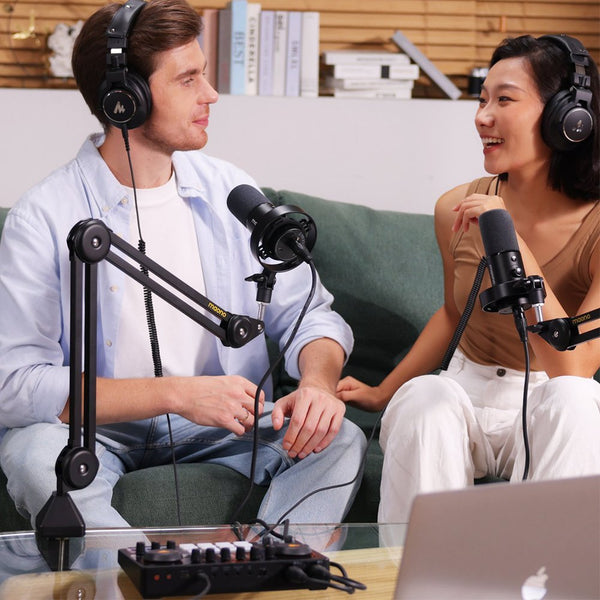
A podcast might begin at a desk and continue as an on-location interview. A YouTube creator might record a voice-over through USB, connect to a camera for the next shoot, and return to an XLR setup in the studio. A creator working alone might need one microphone to cover several different production environments.
PD500W needed to work with that reality.
Turning Creator Problems Into Product Priorities
As we organized the feedback, four recurring needs became clear.
Creators wanted:
- Sound they could trust
- More flexibility across devices and recording environments
- Protection for moments that could not be recorded again
- A simpler path from setup to finished content
These needs became the foundation of PD500W.
Instead of designing the product around one connection method, the team developed a hybrid dynamic microphone that supports wireless, USB-C, XLR, and built-in recording.
USB-C provides a direct computer workflow. Wireless supports compatible computers, phones, and cameras. XLR allows the microphone to fit into a traditional audio-interface setup. Built-in recording gives creators another way to capture and protect their audio.
The goal was to make one microphone useful across more creator setups without asking people to replace equipment that already worked for them.
Designing Safer Recording for Moments That Cannot Be Repeated
Sound quality was only part of the challenge.
For podcasters, interviewers, voice actors, and video creators, the greater risk is sometimes losing the recording completely. An important answer, reaction, or performance may happen only once.
PD500W includes 32GB of built-in storage and supports 32-bit float internal recording. It can save audio inside the microphone while simultaneously sending a signal to a compatible computer, phone, or camera.
A dedicated -9 dB safety track provides a lower-level version of the same moment if the main signal becomes unexpectedly loud.
These features were designed to give creators another layer of recording protection without requiring a more complicated setup.
Building the First Working Prototypes

Once the main workflow had been defined, the team began turning it into a working product.
PD500W prototypes were evaluated across the recording paths creators were most likely to use:
- XLR recording through an audio interface
- USB-C recording with a computer
- Wireless recording through the receiver
- Built-in recording and file export
- Mobile and camera workflows
- Headphone monitoring and onboard controls
- Long-form recording and livestreaming
The early units proved that the hybrid concept could work. They also showed that a product is not ready simply because its main features function.
Buttons, indicators, software behavior, mounting compatibility, connection stability, and documentation all affect whether the microphone actually feels easy to use.
That was why the next stage had to take place outside the lab.
Putting PD500W Into Real Creator Workflows
Early testers used PD500W in real production environments instead of limiting the evaluation to standardized test scripts.
They recorded voice-over content, connected the microphone through XLR, compared different connection modes, tested wireless workflows, streamed for several hours, recorded outdoors, and used the built-in recording as a genuine backup during video production.
These tests confirmed several of the product's intended strengths. Testers responded positively to its voice-focused sound, hybrid connectivity, built-in recording, construction, and ability to move between different recording setups.
They also found details that needed more work.
Testers told us when the touch-to-mute area was too easy to activate while repositioning the microphone. They identified an intermittent wireless issue during a long livestream. They showed us how the connector position could make installation difficult with certain boom arms.
They also asked for clearer explanations of indicator lights, internal recording, file export, and software controls.
The testing program focused on finding the points where a promising product still created friction.
From Feedback to Product Improvements

The team reviewed the feedback, reproduced reported issues, and translated the findings into specific product changes.
Reducing Accidental Muting
Creators sometimes touched the mute area while adjusting or removing the microphone, causing an unexpected interruption.
The team refined the touch behavior and developed a Mute Lock solution to help prevent accidental activation during recording or livestreaming.
Improving Wireless Stability
A tester reported intermittent wireless interruptions during an extended livestream.
The engineering team reproduced and investigated the issue, then adjusted the hardware configuration and connection-matching solution to improve wireless stability in production units.
Upgrading the Physical Controls
Testers liked the overall build but felt that metal controls would better match the microphone's professional positioning.
The relevant microphone and stand controls were upgraded from plastic to metal, improving both tactile feel and visual consistency.
Supporting More Boom Arm Setups
Prototype testing showed that the XLR connector position could interfere with installation on certain boom arms.
An extension component was added to the production package to accommodate a wider range of mounting configurations.
Making the Product Easier to Understand
Some testers had difficulty understanding indicator-light colors, built-in recording controls, and the file-export process without searching through online support content.
The team expanded operating guidance and added clearer instructions around device status, internal recording, and file transfer.
Not every community request could become part of the first production version. Suggestions involving additional audio processing, more detailed metering, control locks, power management, and broader accessory compatibility were also recorded for continued product development.
We investigated each request, explained what was possible, and improved the product where the evidence was clear.
Returning to the Community After Kickstarter

After the campaign, we reached out to our community of 279 backers to better understand what had influenced their support, how they planned to use the PD500 Series, and what information they still needed from us.
The results reinforced an important point: sound quality remained the entry requirement, but creators were not choosing PD500W for sound alone.
They were also looking for a microphone that could move between different devices and production environments, protect important recordings, and reduce the amount of equipment needed to begin creating.
Respondents also told us which content gave them the most confidence before backing the project. Wireless and mobile-recording demonstrations, microphone comparisons, technical tests, raw voice recordings, and creator reviews were among the most helpful forms of evidence.
At the same time, they wanted clearer answers about real battery performance, differences between USB, wireless, and XLR workflows, DSP behavior, device compatibility, built-in recording, file export, and the practical value of 32-bit float recording.
These findings now guide the tutorials, compatibility information, sound tests, FAQs, and creator demonstrations we are preparing for the wider launch. They gave us a clearer view of the priorities and unanswered questions among the backers who participated, and another opportunity to keep listening after the campaign ended.
Together, the survey responses and hands-on prototype feedback helped us move from a successfully funded idea toward a product prepared for a wider group of creators.
From Kickstarter to Official Launch
Following its successful Kickstarter campaign, PD500W will launch on Maono.com and Amazon on November 9.
Reaching the market is the result of the work that began with creator research and continued through prototype testing and refinement.
We began by studying creator pain points and the workflows behind them. We then developed prototypes, tested them in real creator environments, investigated the feedback, and refined the product for launch.
The result is a hybrid dynamic microphone designed around four priorities:
- Reliable, voice-focused sound
- Flexible connection across creator workflows
- Built-in protection for important recordings
- A simpler way to start creating
PD500W is designed to complement existing equipment and give creators more options, whether they are recording at a desk, in front of a camera, on a phone, or through an existing XLR setup.
Thank You to the People Who Helped Build PD500W
To all 279 Kickstarter backers: thank you for believing in PD500W and helping bring the project to life.
Your support gave us more than a successful campaign. Your questions, recordings, tests, and feedback showed us how the product performed when it left our lab and entered real creator workflows.
We would also like to recognize the creators and early testers who contributed their time and experience throughout the project.
Special Thanks to Our Beta Testers
The following comments show how beta testers and reviewers experienced PD500W in their own workflows.
Davesoltura | Voice Actor / Podcaster / Content Creator : "As a voice actor for 14 years, this is exactly what I’ve been waiting for: a plug-and-play, broadcast-quality phone mic that simplifies setups, ensures failsafe recording, and boosts editing efficiency."
lightning-audio-and-reviews | Content Creator / Podcaster / Audio Engineer: "XLR sound quality test: the PD500 can hold its own against high-end popular microphones. If both were $350 and durable, I'd pick this over the SM7B. Looks similar, sounds similar, same audio quality, more features."
Michael Noble | Music Producer / Content Creator : "Instead of doing what a lot of other brands do where they create a product and then cut out mainline features and sell them separately, Maono is giving it all to us in one big package."
TeftyTeft |Music Producer / Audiophile: "This is kind of possibly the future of microphone tech, it just makes sense that all these things would kind of come together into one product and sound really good."
thomas_j_mcclure | Videographer / Director: "The interesting thing about this microphone and probably the the most popular thing about this microphone is its connectivity. I think it does sound very good. I'm very happy with the sound quality of the microphone.
We also thank every early tester and community member who shared recordings, tested new workflows, reported issues, and stayed in the conversation as the product evolved. Special thanks to Rebecca, our UK voice-over contributor, for lending her voice to the project.
The Kickstarter campaign may be complete, but the work of listening continues.
Thank you for helping us build PD500W.
Your voice matters. Let the world hear it.
Explore PD500W
PD500W launches on Maono.com and Amazon on November 9th.
- Explore PD500W on Maono.com, subscribe now to get notified before it officially launched.
- Read the PD500W Setup Guide
- Join the Maono Community Join the Maono Community